Imagine you live in a US city where privacy-conscious decisions matter: you run a small consultancy, accept crypto payments from clients, and occasionally move funds between Monero (XMR), Bitcoin (BTC) and a privacy-leaning asset like Haven (XHV). You want a single wallet that keeps your IP and transaction graph as private as reasonably possible, avoids shipping your keys to a third party, and still lets you swap assets quickly when the market or a client invoice demands it. The choices you make — which wallet, which node, whether to route through Tor, how to store your seed — determine the practical privacy you actually get, not just the theoretical features on a product page.
This article walks through that concrete case. I’ll explain how modern privacy wallets stitch together techniques from network-level anonymity (Tor/I2P), cryptocurrency protocol privacy (Monero’s ring signatures, Litecoin MWEB, Zcash shielded addresses), device-level protections (Secure Enclave/TPM), and cross-chain routing (NEAR Intents). We’ll compare trade-offs, point out where privacy weakens in practice, and offer a short decision framework for U.S.-based users who need both convenience and measurable privacy guarantees. Along the way I use the Cake Wallet ecosystem as a running example for how these mechanisms are combined in a multi-currency client.
How privacy stacks are built: three layers that matter
Think of a privacy wallet as built from three semi-independent layers that combine to produce (or undermine) real privacy: network anonymity, transaction-layer privacy, and key custody/device security. Each layer has its own mechanisms and failure modes.
1) Network anonymity: Tor-only mode and I2P proxy support protect your IP from nodes and counterparties. If you run the wallet in Tor-only mode or route through a user-selected node, your public IP is obscured from blockchain peers and swap partners. In the U.S. context — where ISPs, enterprise networks, and public Wi‑Fi often log metadata — using Tor or I2P is a straightforward mitigation. But note the trade-off: Tor can add latency and sometimes blocks certain relay services; misconfigured bridges or DNS leaks can still reveal metadata if the wallet or OS leaks outside the proxy.
2) Transaction-layer privacy: different coins use different privacy constructions. Monero (XMR) provides built-in privacy via ring signatures, confidential transactions, and stealth addresses; the private view key remains on-device to preserve receiver privacy. Litecoin offers optional MWEB (MimbleWimble Extension Blocks) to add a confidentiality layer. Zcash can use shielded (z-) addresses to hide inputs and outputs; Cake Wallet enforces mandatory shielding on all outgoing ZEC transactions so funds don’t leak from transparent addresses. But each construction has limits: MWEB is optional and requires counterparties that support it; Zcash shielded pools are powerful but historically less liquid and sometimes slower; Monero’s privacy is strong in practice but depends on ring size, wallet updates, and network heuristics.
3) Key custody and device security: a non-custodial architecture and device-level encryption (Secure Enclave on iOS, TPM on Android) mean the private keys never leave your device unless you export them. Cake Wallet’s design is open-source and non-custodial; pairing with hardware like Ledger or an air-gapped Cupcake increases security for high-value holdings. But hardware integration adds operational friction: you must maintain firmware updates, physically secure backup seeds, and be wary of supply-chain risks if you buy devices from untrusted channels.
Cross-chain swaps and decentralized routing: the role of NEAR Intents
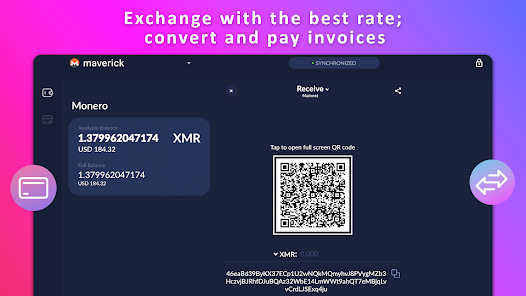
One reason multi-currency wallets are tempting is convenience: you want to swap XMR for BTC without exposing funds to a centralized exchange. Decentralized routing via NEAR Intents is a useful mechanism here. It programmatically queries multiple market makers to find competitive exchange rates and constructs a route without funneling orders through a single custodial counterparty. For our U.S. user, this reduces reliance on centralized exchanges that may retain KYC records tied to bank accounts or IPs.
But decentralized routing introduces new considerations: liquidity fragmentation, potential timing leaks during multi-step swaps, and competitor maker behaviors. NEAR Intents automates route selection, yet the privacy and final cost depend on the depth of liquidity and the anonymity of the market makers involved. In practice NEAR Intents is a strong step toward trust-minimized swaps, but it is not a magic bullet: routing paths can still reveal metadata if participants correlate messages or if external observers monitor on-chain flows at the same time.
Case-specific mechanics: migrating Zcash and the Zashi limitation
Small technical choices can have outsized privacy effects. For example, if you are moving ZEC from a Zashi wallet into Cake Wallet you must manually transfer funds because Zashi seed phrases are incompatible with Cake’s ZEC wallet change-address handling. That matters because some users assume seeds are portable across any wallet for a given coin. In reality, differences in how change addresses or derivation paths are handled can break migration or — worse — expose funds if a user imports incorrectly. The practical takeaway: verify migration paths and, when necessary, perform a small test transfer before moving the full balance.
Monero and Haven: what each brings and where they diverge
Monero remains the default for transactional privacy: mandatory stealth addresses and ring signatures are native to the protocol, and Cake Wallet preserves the private view key on the device while supporting subaddresses and background sync. Haven (XHV) takes a different approach: it provides “offshore” style assets—private synthetic assets representing stable assets or other units—built on top of privacy primitives. For a U.S. user, Haven can be useful for private peg-like functions (holding value in a private representation of USD, for instance), but it comes with trade-offs in liquidity and broader ecosystem acceptance compared with XMR and BTC.
Key divergence: Monero’s widespread node support and steady liquidity mean transaction fees and exchange routes are generally reliable. Haven offers a more specialized use-case; it’s powerful if your workflow requires private synthetic representation of other assets, but that specialization increases counterparty risk and reduces on‑ramps off-ramp options in the U.S. market.
Where privacy collapses in practice: realistic failure modes
Privacy is compositional: the weakest layer often defines the outcome. Some common collapse modes:
– Endpoint leaks: If the wallet is misconfigured and connects to a public node without Tor or uses a system-level analytics library, IP metadata can leak despite on-chain privacy.
– Migration mistakes: Importing seeds with incompatible derivation schemes (the Zashi → Cake ZEC case) can leave funds stranded or create reuse signals.
– Off-chain correlation: Swapping through market makers or on-chain timing correlations can allow powerful adversaries (e.g., chain analysts with exchange data) to narrow down participants.
– User operational errors: weak backups, using cloud-synced screenshots of seed phrases, or reusing addresses in non-private chains quickly negate protocol-level privacy.
Being honest about these is not fear-mongering but a realistic way to allocate protection: fix the easiest failures first (use Tor-only, never photograph seed phrases, test migrations), and then layer device-level hardware if needed.
A practical decision framework for a US user
Here’s a simple heuristic to choose settings and prioritize effort.
1) Threat model triage: identify whether you worry most about casual observers (ISPs, employers), powerful correlators (exchanges, chain analytics firms), or state-level actors. Tor + subaddresses + non-custodial keys are high value everywhere; hardware wallets matter more if you face targeted theft or legal seizure risks.
2) Minimum deployable privacy: enable Tor-only mode, connect to a custom node for XMR if you can run one or trust a small set of community nodes, and keep the view key on-device. Test a small swap through NEAR Intents to see latency and costs before moving large amounts.
3) Upgrade path: for mid-level risk, add a hardware wallet (Ledger/Cupcake), and use MWEB for LTC when counterparties support it. For high-risk scenarios, avoid custodial exchanges entirely, route swaps through decentralized intents, and accept operational friction for air-gapped signing.
For users who want to evaluate a concrete multi-currency app that implements these choices, the cake wallet ecosystem exemplifies many of these trade-offs: open-source non-custodial design, Tor/I2P options, mandatory ZEC shielding, integrated NEAR Intents for swaps, Monero view-key safety, MWEB support for Litecoin, and hardware integrations. Use that example as a checklist rather than an endorsement: check each setting against your threat model and do a live dry run.
What to watch next (near-term signals)
Three signals will matter over the next 12–24 months for U.S. privacy users: adoption of shielded pools (ZEC) and MWEB by exchanges and services, improved decentralized routing liquidity for NEAR Intents-style swaps, and regulatory attention to privacy tools. If exchanges continue to add shielded support and decentralized makers deepen liquidity, swaps will become faster and cheaper without sacrificing privacy. Conversely, stronger regulatory pressure or forced KYC on liquidity providers could push more activity to private, less-liquid venues — improving privacy for a few but raising costs for most.
FAQ
Q: If I use Tor-only mode, do I need to do anything else to protect my privacy?
A: Tor-only mode protects IP-level metadata but is not sufficient alone. Combine it with on-device key safety, avoid exporting private view keys, use subaddresses for Monero, activate MWEB or shielded addresses where available, and avoid reusing addresses across blockchains. Also test for OS-level leaks and keep your wallet software up to date.
Q: Is decentralized routing via NEAR Intents fully anonymous?
A: No single system guarantees total anonymity. NEAR Intents reduces dependence on centralized intermediaries and improves route competitiveness, but parties along a swap route can still observe timing and value flows. It’s a privacy improvement versus centralized exchange swaps, but not an absolute safeguard against correlation by well-resourced adversaries.
Q: Should I move Zcash from a Zashi wallet into a Cake ZEC wallet using a seed import?
A: You should not rely on seed import if the wallets use different change-address schemes. The known limitation means manual transfer is required: create a new Cake ZEC wallet and send a small test amount first. This avoids lost funds or address reuse that would degrade privacy.
Q: For U.S. users, how important is hardware wallet integration?
A: It depends on your threat model. For everyday privacy from casual observers, software protection and Tor are often sufficient. If you hold larger sums, expect legal risk, or want to minimize key extraction risk, hardware wallets (Ledger or air-gapped solutions like Cupcake) materially raise the bar against theft and device compromise.
Closing thought: privacy is not a single switch you flip but a set of choices and trade-offs. Start with a clear threat model, harden the weakest layer first, and test small transfers. For multi-currency convenience without surrendering control, combine open-source non-custodial software, network-level anonymity (Tor/I2P), protocol-native privacy (XMR, shielded ZEC, MWEB), and hardware custody where appropriate. Those steps will get you most of the practical privacy that is achievable today while keeping options open as the ecosystem and regulations evolve.